The Gallic Wars occurred from 58-50 BCE when Julius Caesar attacked the Gallic tribes. They took place in Gaul, Germania, and Britannia. As a result of Caesar’s being consul in 59 BCE, he had lots of debt to pay. Through the First Triumvirate, though, Caesar had become proconsul in the provinces, Cisalpine Gaul and Illyricum. He also got control of Transalpine Gaul. He had the idea to conquer more provinces to get himself out of debt. His initial target was Dacia in the Balkans. The first battle was fought between Caesar and Helvetii (a Gallic tribe) in 58 BCE. This battle was called the Battle of Arar. The Helvetii were crossing the Arar river and were attacked by the Romans. The outcome of this battle was a Roman victory. In one part of this battle, the Helvetii had people positioned on the near bank of the Arar and were attacked by the Romans. Another battle was the Battle of Bibracte, fought in 58 BCE. This was also a Roman victory. The Romans routed the Helvetii and won the battle. The Battle of Vosges was fought in 58 BCE against the Sequani. The Sequani were led by Ariovistus. The Romans were able to take over some of the Sequani camps and won this battle. The Sequani were German. In the Battle of Sabis River, fought in 57 BCE, led to a Roman victory. The Battle of Axona was fought in 57 BCE was another Roman victory and marked the end of the campaigns against Gaul. The next series of battles were against Northern Gaul and Britain. After the wars before, the Romans owned the Rhine Valley. The Veneti did not want to become occupied by Caesar, but Caesar wanted to defeat them. The Battle of Action of Brittany was fought in 56 BCE was waged in the sea. The Romans won. The next battle, Battle of Treveri, happened in 55 BCE. This battle was said to be a massacre of the tribe Asipetes (German). The Romans had yet another victory. There were two Battles of Britain, one in 55 BCE and another in 54 BCE. In the first battle, the Romans stopped fighting because of the weather, but it is still counted as a Roman victory. In the second battle, the Romans took hostages and withdrew again, but it was a Roman victory. The next set of wars are called the Rebellion of Vercingetorix. The first battle, Battle of Adnatuca, was waged in 53 BCE against Gaul (the tribe Eubrone). However, the Romans were commanded by a different general, Titurius Sabinus. Gaul won in this battle. Sabinus was killed in the battle as well. The next battle was the Siege of Avaricum, fought in 53 BCE and Caesar was once again in charge of Roman armies. This led to another Roman victory. In the Battle of Gergovia, waged in 52 BCE, left Gaul with victory over Rome. In the Battle of Agedincum, fought in 52 BCE, with Labienus in command of the Roman army. The last battle of the Gallic Wars was the Siege of Alesia. It was fought in 52 BCE. Caesar led the Romans and Vercingetorix led Gaul. In this battle, Rome was at first on the defense because Gaul was attempting to make it difficult for Caesar to contact allies. They were also stocking up on food in major cities so Caesar would attack them there (those cities were heavily protected and Gaul attacked other places). Caesar captured the Bourges and regained the upper hand. Caesar then made an “obstacle course” of defense that included wood blocks with iron hooks fixed in them and a field sharp stakes in pits. The Romans ended up winning the Siege of Alesia. All in all, the Gallic Wars were devastating. Hundreds of thousands of the opposers of Caesar were killed or injured and Rome suffered 40,000 deaths or injuries. However, Caesar was not done with what is now Europe quite yet. | 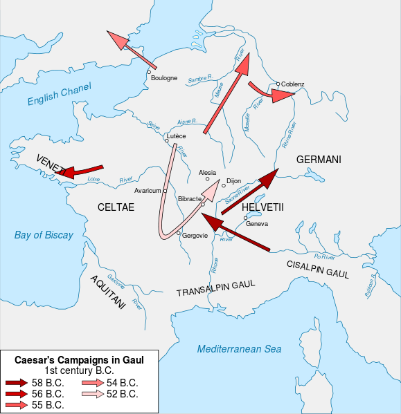 Caesar's Campaigns in Gaul |
